THE ARTIST
ROBERT PENKWITT
There had been photographers in the family for three generations, so cameras and photographs were ordinary things to us. They belonged to the house in much the same way as the kitchen did, or the oven, or the view of the fields outside.
What I remember most clearly from my childhood years are simple things, like how my father taught me about light and how he could tell that the light had changed by feeling it on his skin. He showed me how to notice it too. And my grandfather showed me his darkroom skills and his etching techniques. The beautiful scent of etching ink is still with me, even after all this time.
My grandmother instilled in me my great love for cooking and baking and showed me how to give things the time they needed. There was no point in trying to hurry bread. And in the centre of all of that was the hearth, a word I only learned much later means focus in Latin. That makes so much sense.
My next focus and passion was on studying art and eventually graduating after eight years at the Academy of Fine Arts in Stuttgart. It was a time of experimentation, inspiration and a vibrant exchange with fellow artists, and at the same time, hours on end spent alone in my atelier.
Alongside painting, I continued to use the camera as a means of expression and eventually spent more than three decades travelling as a professional photographer, a constant supply of cities, people, aeroplanes, hotels, studios and conversations, and always another place to go. It was an exciting time of my life, and I kept learning and discovering new things every day.
Photography is still part of me, and I don't imagine that will ever change, but it was a life lived mostly outwards.
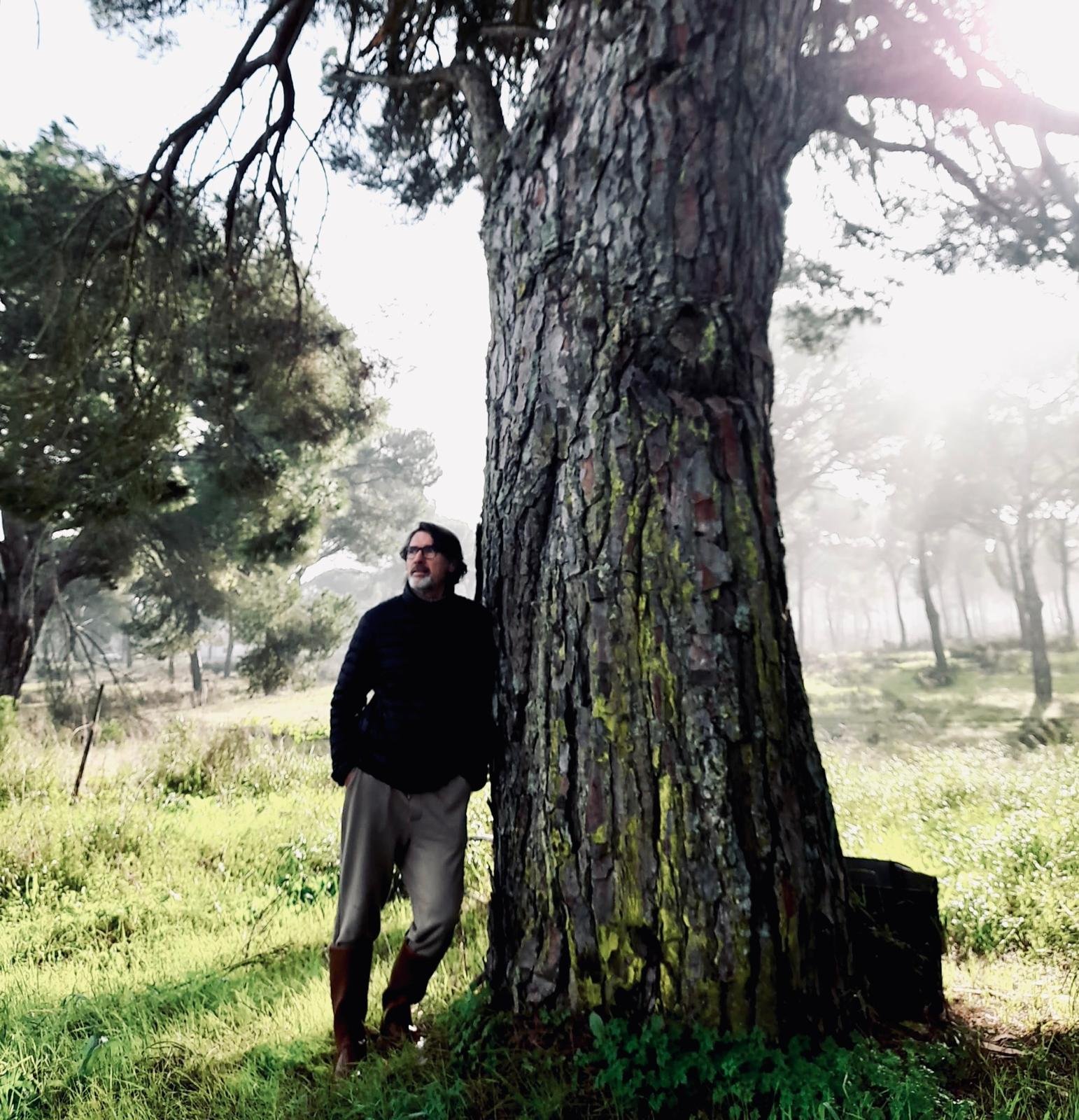
Now I live surrounded by cork oaks and olive trees and pines and sheep in the fields of the Alentejo in Portugal. The land is open and the light changes all day. After travelling for so many years, I've rediscovered the pleasure of staying in one place. The tumbleweed has grown roots.
You begin to notice different things when you stay somewhere for a while. You notice when the grass changes, when the first heat comes, when the sheep have moved from one field to another, and the birds sing different songs. You begin to know the silence, although after a while you realise the silence is not silent at all.
I like the space around things. This is why there aren't any people in my art. They make too much noise.
My paintings begin quietly. I don't know where they're going, and I've learned to like not knowing. I put something down, then I cover it. I wait. I draw into it, erase something, make a mark, spoil something that was working, and sometimes discover that spoiling it was exactly what it needed.
There are many layers. Some days the work is only quiet. On others, I make a mess and enjoy making it. Eventually something begins to appear. This requires patience. And it is so similar to what my grandmother taught me in the kitchen: you cannot hurry anything.
Painting has become a kind of prayer for me, not in the formal religious sense. It's simpler than that. It's giving something your attention for a long time, looking, waiting, being grateful that there is something there to look at.
I spend much of my life reading, and some of the writers have helped me look differently at what is around me, the ordinary. I'm interested in that. A tree, a stone, an animal. Something does not have to stop being itself in order to contain something else.
Sheep came into the paintings almost naturally. A sheep carries an enormous history with it. There is religion and sacrifice, innocence and pastoral life, mythology and belonging. All of that is there whether I ask for it or not.
Then there is the sheep itself, standing in a field. It does not know any of this. It eats, it looks up, it stands in the sun, walks away. Something about that moves me on a deep level.
The sheep are not only sheep. They are also only sheep.
That's enough.
I've called my latest series of paintings Nostos. The ancient Greek word means return or homecoming. It feels like finding my way back to something very simple that was there in my childhood before all the travelling and the noise, something I had once known without knowing I knew it, and which, now that life has become quieter, I'm beginning to recognise again.
Robert Penkwitt